Key takeaways
- An RPZ (reduced pressure zone) assembly has two check valves and a relief valve between them.
- RPZs protect high-hazard connections, such as restaurants, medical offices, boilers and chemical feeds.
- In Austin Water's service area, every RPZ must be tested every year by a TCEQ-licensed tester.
- Water from the relief port means the RPZ is protecting the supply, or that it needs repair. Never plug it.
- An RPZ belongs above ground, never in a pit that can flood.
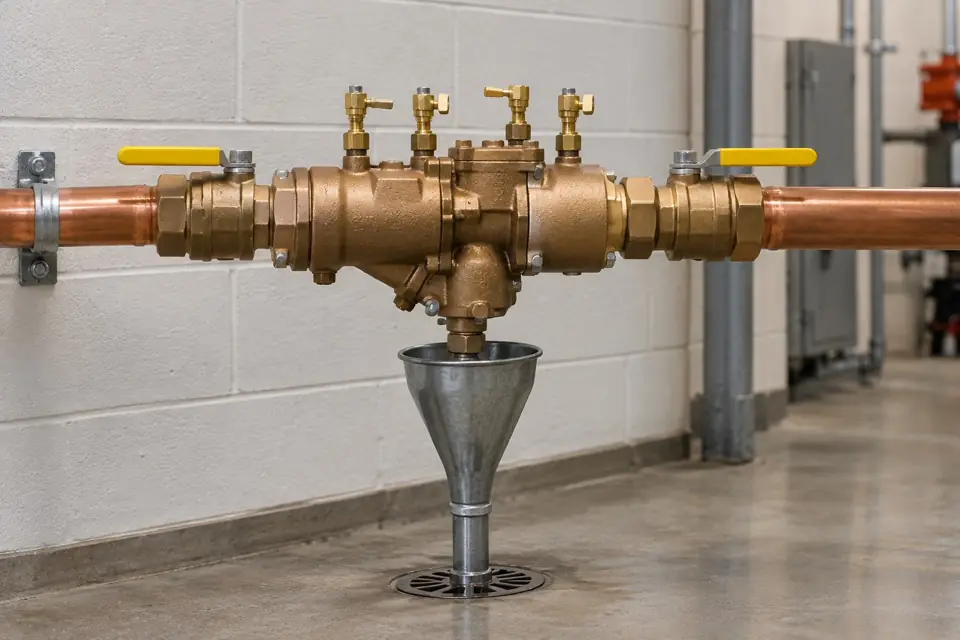
If your building has a bronze assembly with two shutoff valves, four small test cocks and a funnel-shaped port underneath, it's probably an RPZ. Typical places to find one are restaurants, medical and dental offices, car washes, labs, buildings with boilers or chemical feeds, and some irrigation systems with chemical injection. Your water utility decides which assembly each connection needs.
This guide explains what the RPZ does, why it sometimes spits water, how the annual test works, and what to expect when it fails. For prices, see our backflow testing cost guide.
How an RPZ valve works
Water passes through two independent check valves in a row. Between them is a small chamber, the reduced pressure zone, held at a lower pressure than the supply side. A spring-loaded relief valve connects that zone to the outside.
A check valve is a spring-loaded valve that lets water flow only one way. In normal flow, both checks are open and the relief valve stays shut. If supply pressure drops (a main break or heavy firefighting draw) or building pressure rises (a pump or boiler), the checks close. If the first check leaks, zone pressure rises toward supply pressure; if the second check leaks under backpressure, building water pushes into the zone. Either way, the relief valve opens, discharging water out of the bottom port. The water goes onto the floor or the ground instead of back into the city main. That's why an RPZ is the assembly required for high-hazard connections.
Why is my RPZ dripping or discharging?
Occasional spitting during sudden pressure changes can be normal. The relief valve is reacting to a short pressure swing.
A steady drip usually means the first check valve isn't sealing: debris on the seat, a worn disc or a weak spring. The relief valve is doing its job by dumping the leakage.
A heavy, continuous discharge usually means a check valve is stuck open or the relief valve diaphragm has failed. Call for service. Don't plug or cap the relief port. That would turn off the safety feature.
After a freeze, a cracked body or bonnet can leak from places other than the relief port. Uninsulated outdoor RPZs are vulnerable to freeze damage. See the freeze-proofing checklist.
| Assembly | Hazard level | Relief valve | Typical use |
|---|---|---|---|
| RPZ (reduced pressure zone) | High (health hazard) | Yes, discharges water if backflow conditions develop | Domestic service for restaurants and medical buildings, boilers, chemical feeds, some irrigation |
| Double check valve assembly (DCVA) | Low (non-health hazard) | No | Lower-hazard connections, such as some fire sprinkler lines (the utility decides) |
| Pressure vacuum breaker (PVB) | Backsiphonage only | No (air inlet instead) | Irrigation systems |
How an RPZ is tested in Austin
A tester licensed by the Texas Commission on Environmental Quality (TCEQ) shuts off the water briefly and connects a calibrated pressure gauge to the test cocks. The tester then checks three things. The first check valve must hold the required pressure difference. The relief valve must open at the right point. The second check valve must hold tight.
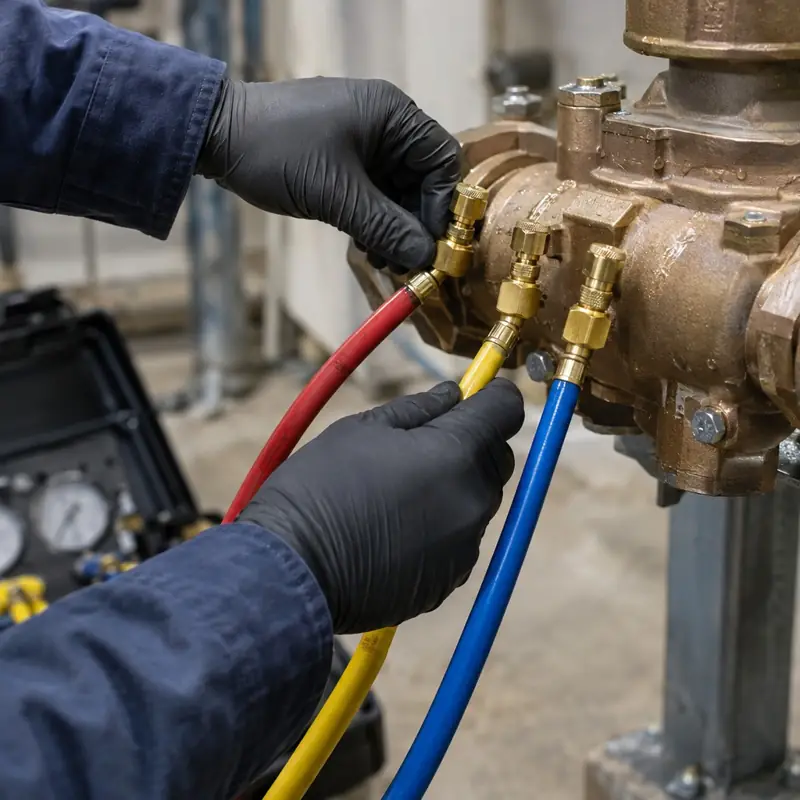
In Austin Water's service area, each assembly is tested when it's installed, every year after that, and again immediately after any repair (Austin City Code §15-1-12). The tester files the result online, through Austin Water's new Klir system, which replaced WEIRS on November 9, 2026 (tester information). Nearby cities such as Round Rock run their own programs. See what backflow testing is and backflow testing and repair.
RPZ repair vs. replacement
Most failed RPZs are repaired, not replaced. A rebuild kit is the set of replacement rubber parts for one model: check discs, seats, springs and the relief valve diaphragm. After it's installed, the assembly is retested, as Austin City Code §15-1-12 requires, so a passing result can be filed. In the Austin area that typically runs about $200 to $600, including the retest, for common 3/4" to 2" assemblies (2026 estimate).
Replacement makes sense when the body is cracked, parts are no longer made for an old model, or the assembly is the wrong type or size for the hazard. A new small (3/4" to 2") RPZ installed typically runs about $800 to $2,500 (2026 estimate). Larger sizes and fire-line assemblies cost more. All figures are general estimates, not quotes.
Installing an RPZ the right way
The relief valve can discharge a lot of water, so an RPZ belongs above ground, never in a pit or vault that can flood. Leave room around it for testing and a place for the discharge water to drain. Indoors, that means a floor drain or an air-gapped drain funnel that can take a full discharge. Outdoors in Austin, it means an insulated enclosure for the occasional hard freeze. In Austin, City Code §15-1-14 bars backflow devices with atmospheric vents or ports from pits, underground or submerged locations. Your water utility and the plumbing code set the exact clearances, so confirm them before the assembly goes in.
RPZ valve services: testing, repair and installation
Most RPZ work falls into three services. The first is the annual test (often called the RPZ inspection). The second is repair or rebuild after a failed test. The third is installing a new assembly. Austin Water requires testing by a TCEQ-licensed tester registered with the City. Repairs are done by a tester or licensed plumber, and installation is plumbing work, so check the permit requirement with your city first. Track each assembly's due date with the free compliance calendar.
Need one of these? Request backflow testing, repair or installation.
Example: an RPZ that sprays water after a pressure change
A dental office sees water spraying from the RPZ's relief port after the City works on the water main down the street. A short discharge during a pressure swing is the RPZ doing its job.
If the water keeps running after the pressure settles, debris or a worn part is holding a check valve open. The assembly then needs a tester to repair and retest it. Before the tester arrives, have the last test report ready and agree on a short shutoff window.
Related services
Who this guide is for
Frequently asked questions
What does RPZ stand for?
Reduced pressure zone. It's the low-pressure chamber between the two check valves. The full name is a reduced pressure principle backflow prevention assembly.
Is it normal for an RPZ to drip?
An occasional spit during a pressure change can be normal. A steady drip or a continuous discharge means a check valve or the relief valve needs service. Never plug the relief port.
How often does an RPZ have to be tested in Austin?
Every year in Austin Water's service area, plus a test when it's installed and a retest immediately after any repair. The test must be done by a TCEQ-licensed tester, who files the result with the utility.
What's the difference between an RPZ and a double check valve?
Both have two check valves, but only the RPZ has a relief valve that discharges water when backflow conditions develop. That makes the RPZ the choice for high-hazard connections, while double checks are used for lower-hazard ones.
How much does RPZ repair cost in Austin?
Typically about $200 to $600 for a rebuild kit installed, including the retest, for common 3/4" to 2" assemblies (2026 estimate). Replacing a small RPZ typically runs about $800 to $2,500. These are general estimates, not quotes.
Can an RPZ be installed underground?
It shouldn't be installed in a pit or vault that can flood, because the relief port must never be submerged. In Austin, City Code §15-1-14 bars backflow devices with atmospheric vents or ports from pits, underground or submerged locations. RPZs go above ground, with room to test and a place for discharge water to go.
Methodology: how this guide was put together
This guide is our editorial team's summary of the backflow requirements published by the Texas Commission on Environmental Quality and Austin Water, linked under Sources. It follows our editorial policy.
The repair and replacement figures are 2026 editorial estimates for common 3/4" to 2" assemblies. They are editorial judgments, not survey data or quotes.
Sources
- TCEQ: Cross-Connection Control and Backflow Prevention
- TCEQ RG-478: Establishing and Managing an Effective Cross-Connection Control Program (revised February 2026)
- Austin Water: Backflow Prevention Overview
- Austin Water: Cross Connection Control / Water Protection Program
- Austin City Code §15-1-14 (Chapter 15-1, cross-connection regulations)
- Austin Water: Backflow Prevention Assembly Tester Information (WEIRS to Klir)
- 30 TAC §290.44 (Water Distribution), via Cornell LII
- Austin City Code §15-1-12 (testing, repair and retest)