Key takeaways
- Backflow testing proves that a backflow assembly still keeps building water out of the public water supply.
- Austin Water requires annual testing of backflow assemblies in its service area, under its cross-connection control program.
- The test must be done by a tester licensed by the Texas Commission on Environmental Quality (TCEQ) and registered with Austin Water.
- A failed assembly usually looks normal from the outside. The yearly test is the only way to know it works.
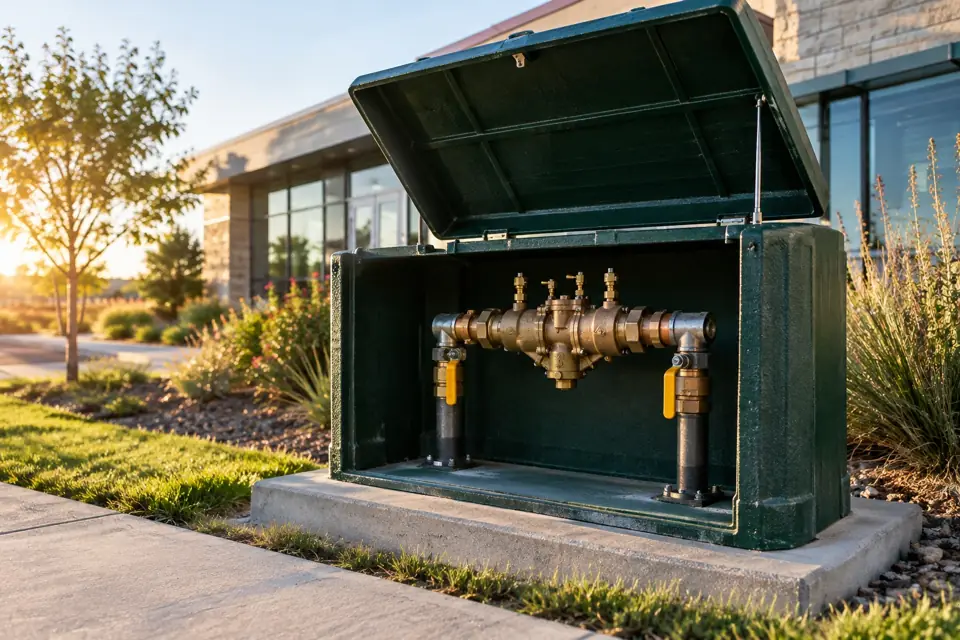
Every building connected to a public water system is connected to everyone else on that system. If pressure in the city main drops, during a main break or heavy firefighting demand for example, water can be pulled backward out of a building. That water might carry irrigation fertilizer, boiler chemicals, soap from a dish machine or medical equipment fluids. A backflow prevention assembly is the valve that stops it.
Because a failed assembly usually looks perfectly normal from the outside, the only way to know it works is to test it. That's what backflow testing is.
What backflow is: backpressure and backsiphonage
Backsiphonage is backflow caused by a drop in supply pressure (Austin City Code §15-1-2 defines both terms). For example, during a water main break, water can be pulled backward from the building into the main.
Backpressure is backflow caused by pressure inside the building's system being higher than the supply pressure. Pumps, boilers and elevated tanks can push water backward into the public system.
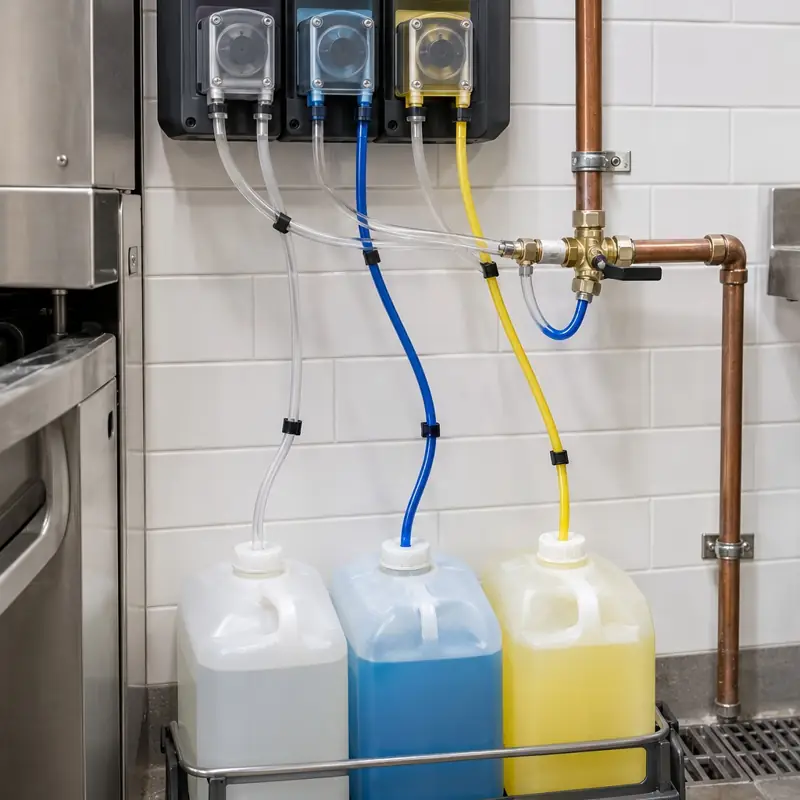
A cross-connection is any point where drinking water could touch something else. Common examples are an irrigation system, a boiler, a chemical feeder, a fire sprinkler system and a soda machine. Backflow assemblies are installed at these points.
The main types of backflow prevention assemblies
The assembly type depends on the hazard. The table below covers the testable assemblies you're most likely to have at an Austin commercial property.
| Assembly | How it works | Typical commercial use |
|---|---|---|
| Reduced pressure zone (RPZ) | Two check valves with a relief valve between them that discharges water if backflow conditions develop | High-hazard connections: domestic service for many commercial buildings, boilers, chemical systems, medical equipment |
| Double check valve assembly (DCVA) | Two independent check valves in series | Lower-hazard connections, including many fire sprinkler lines |
| Pressure vacuum breaker (PVB) | A spring-loaded check valve and an air inlet that opens if pressure drops | Irrigation systems (backsiphonage only) |
How a backflow test works
A licensed tester shuts off the water briefly and connects a calibrated pressure gauge to the assembly's test cocks. Then the tester checks each part. Each check valve must hold tight, and on an RPZ the relief valve must open at the right pressure. The readings are recorded on a test report.
If everything passes, the tester files the report with the water utility. If something fails, the assembly is repaired and retested. Water is off during part of each test, so restaurants and medical offices usually schedule testing outside business hours.
Who requires backflow testing in Austin
The State of Texas. TCEQ rules require backflow prevention assemblies that protect against health hazards to be tested at least once a year by a licensed backflow prevention assembly tester. The requirement is in Texas Administrative Code Title 30, §290.44(h).
Austin Water. Austin Water runs a cross-connection control program that sets requirements for installing, testing, maintaining and reporting backflow assemblies in its service area. Testing has to be done by a tester licensed by TCEQ and registered with the City. Test and maintenance reports are submitted online, through Austin Water's new Klir system, which replaced WEIRS on November 9, 2026 (tester information). Under City Code §15-1-12, a repaired assembly must be retested immediately after the repair, and an assembly can't be moved or removed without Austin Water's approval.
Other cities. Round Rock, Cedar Park, Georgetown, Pflugerville and other nearby cities run their own programs through their water utilities, with their own forms and deadlines. Intervals differ too: Round Rock and San Marcos test high-hazard assemblies every year, San Marcos tests low-hazard assemblies every 3 years, and Kyle tests at installation and at least once a year after that. See backflow testing in Round Rock or our full service areas list.
What happens if an assembly fails
Failed tests commonly trace to worn internal parts such as discs, seats, springs or diaphragms. These parts can usually be replaced with a repair kit, followed by a retest so a passing result can be reported (Austin City Code §15-1-12). An assembly with a cracked body, often from a freeze, or with parts that are no longer made, has to be replaced. Read more about commercial backflow testing and repair service and what each option typically costs in our backflow testing cost guide.
How to stay compliant without thinking about it
Keep a list of every assembly at each property: location, type, size, serial number and last test date. Schedule all of a property's assemblies together. Insulate outdoor assemblies before winter (see the freeze-proofing checklist). If you manage several buildings, a preventive maintenance plan can put backflow testing on an annual schedule so due dates never slip. To track the dates yourself, use the free compliance calendar.
Example: a restaurant's first backflow test
A new restaurant tenant learns from the landlord that the RPZ on the kitchen water line is due for its annual test. The manager books a tester who is registered with Austin Water. Before the visit, the manager asks for the tester's TCEQ license number.
The tester shuts the water off briefly, runs the gauge test and files the result. The manager keeps a copy of the passing report with the property's records. If the RPZ fails, the tester quotes a repair, fixes it and tests it again before filing. Why RPZs fail, and why they sometimes drip, is covered in RPZ valves explained.
Related services
Who this guide is for
Frequently asked questions
How often is backflow testing required in Texas?
Under TCEQ rules (30 TAC §290.44(h)), assemblies are tested when they're installed, and assemblies that protect against health hazards are tested at least once a year after that. Austin Water requires annual testing in its service area and a retest immediately after any repair.
Who can do backflow testing in Austin?
A backflow prevention assembly tester licensed by the Texas Commission on Environmental Quality (TCEQ) and registered with the City of Austin. Ask for the tester's license number.
What's the difference between an RPZ and a double check valve?
An RPZ has two check valves plus a relief valve that discharges water if backflow conditions develop, so it's used for high-hazard connections. A double check valve assembly has two check valves and no relief valve, and is used for lower-hazard connections such as many fire sprinkler lines.
Why is my RPZ dripping or spraying water?
The relief valve opens when pressure conditions could allow backflow or when an internal check valve isn't sealing. Constant dripping usually means the assembly needs service (see why RPZs drip). Don't plug the relief port.
Does a homeowner's irrigation backflow device follow the same rules?
Residential irrigation devices are also covered by backflow rules, but commercial properties usually have more and larger assemblies, including RPZs on the domestic service and fire line assemblies. This guide focuses on commercial properties.
Methodology: how this guide was put together
This explainer is our editorial team's plain-language summary of the backflow rules published by Austin Water and the Texas Commission on Environmental Quality, plus the testing intervals posted by Round Rock, San Marcos and Kyle, all linked under Sources. It follows our editorial policy.
If your property is outside the City of Austin, your own water utility sets the testing schedule and how results are reported.
Sources
- TCEQ: Cross-Connection Control and Backflow Prevention
- TCEQ RG-478: Establishing and Managing an Effective Cross-Connection Control Program (revised February 2026)
- Austin Water: Backflow Prevention Overview
- Austin Water: Cross Connection Control / Water Protection Program
- Austin City Code §15-1-14 (Chapter 15-1, cross-connection regulations)
- Austin Water: Backflow Prevention Assembly Tester Information (WEIRS to Klir)
- 30 TAC §290.44 (Water Distribution), via Cornell LII
- Austin City Code §15-1-2 (definitions)
- Austin City Code §15-1-12 (testing, repair and retest)
- City of Round Rock: Backflow Prevention
- City of San Marcos: backflow FAQs
- City of Kyle: Backflow Prevention Program